 French



13 Oct 2026
Share :
Global Rice Market Update October 2026 - Price & Demand Trends | AgriGuru Online
Description:
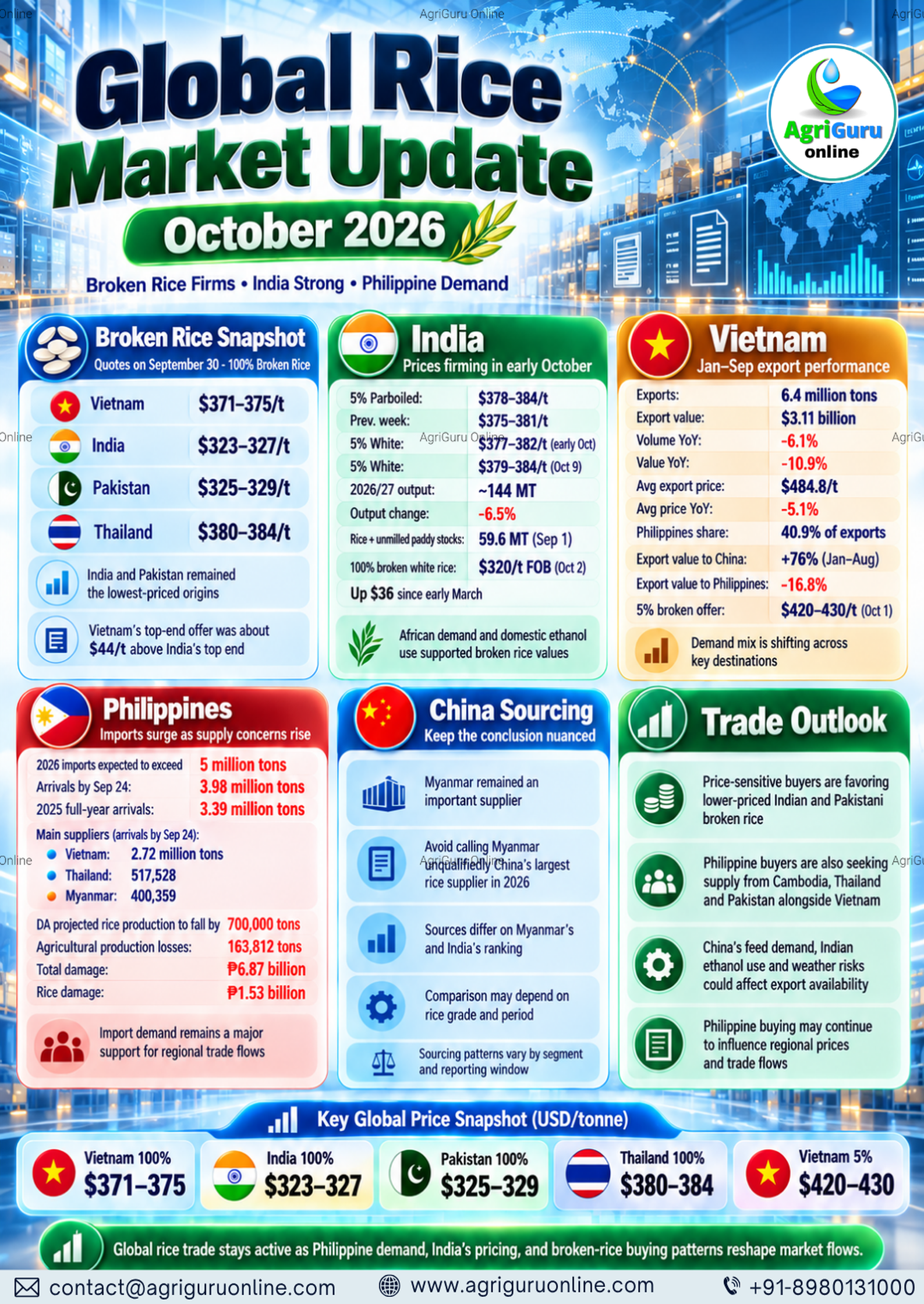
The global rice trade continues to show active momentum through October 2026, driven by surging import demand in the Philippines, firming origin prices in India, and shifts in broken rice purchasing across Asia and Africa.
Key Highlights from the October 2026 Market Infographic:
- Broken Rice Snapshot (100% Broken Rice Quotes): India ($323–327/t) and Pakistan ($325–329/t) maintain their position as the lowest-priced origins for 100% broken rice. Vietnam quotes higher at $371–375/t, while Thailand tops the range at $380–384/t.
- India Market Dynamics: 5% Parboiled rice prices firmed to $378–384/t. 5% White rice touched $379–384/t on Oct 9. Domestic 2026/27 output is projected at ~144 MT (-6.5% YoY), while total rice and unmilled paddy stocks stood at 59.6 MT as of Sept 1. 100% broken white rice reached $320/t FOB (up $36 since early March), buoyed by strong African demand and domestic ethanol utilization.
- Vietnam Export Performance: Jan–Sep export volumes reached 6.4 million tons valued at $3.11 billion. While volume dropped -6.1% YoY and average export price decreased -5.1% to $484.8/t, Vietnam's shipments to China surged +76% (Jan–Aug). The Philippines remains Vietnam's top market, absorbing 40.9% of total exports.
- Philippines Import Surge: Driven by agricultural production losses of 163,812 tons (₱1.53 billion rice damage) and a projected 700,000-ton drop in local output, full-year 2026 imports are expected to exceed 5 million tons (3.98 MT arrived by Sep 24). To diversify risk, Philippine buyers are expanding purchases beyond Vietnam (2.72 MT) into Thailand, Myanmar, Cambodia, and Pakistan.
- China Sourcing Insights: Sourcing patterns remain nuanced across reporting windows and grades, with Myanmar and India playing significant roles in meeting China's feed and broken rice needs.